5 Common SDS Management Mistakes That Could Fail Your Next HSE Audit
5 Common SDS Management Mistakes That Could Fail Your Next HSE Audit (And How to Fix Them)
Let’s be honest: nobody wakes up in the morning excited to audit their chemical safety binder. In most UK workplaces, reviewing Safety Data Sheets (SDS) is an administrative chore that lingers on the to-do list for months.
However, during a Health and Safety Executive (HSE) inspection, local authority audit, or third-party accreditation check (such as ISO 45001 or SafeContractor), that dusty yellow binder in the supervisor’s office is often the very first thing inspectors request.
Under the Control of Substances Hazardous to Health Regulations 2002 (COSHH), having out-of-date or inaccessible safety data isn't just an administrative slip—it's a breach of UK law that can lead to Improvement Notices, Fee for Intervention (FFI) costs, or significant fines.
To help you stay compliant, here are the 5 most common SDS management mistakes that trigger audit failures, along with practical steps to solve them immediately.
1. The "Set It and Forget It" Trap (Using Outdated SDS)
One of the most widespread compliance myths is that a Safety Data Sheet remains valid indefinitely once downloaded.
Chemical manufacturers frequently reformulate products, adjust GHS/CLP classifications, or update toxicological exposure limits. In the UK and EU, REACH Annex II dictates strict formatting and data rules for SDS.
If your team is working with an SDS published in 2018 for a chemical still in active use, your risk assessments are based on potentially outdated hazard data.
- Audit Warning Sign: An inspector spots a document that has not been reviewed within the last 3 years or misses modern 16-section UK REACH formatting.
- The Fix: Implement a scheduled review cadence. At minimum, audit your active chemical register every 12 to 24 months. SDS Flow automatically tracks revision dates and flags documents nearing their review cycle so you never get caught out.
2. Locked-Away and Inaccessible Safety Information
Under COSHH Regulation 12, employers have an explicit duty to provide employees with suitable information, instruction, and training—including immediate access to relevant hazard details.
We frequently see workplaces keep their single master SDS folder in a locked supervisor's office, on a restricted-access desktop computer, or stored miles away in head office.
The 30-Second Rule: If a worker gets an industrial cleaning agent splashed in their eyes, first-aid personnel cannot spend 10 minutes looking for a keyholder or browsing desktop folders.
- Audit Warning Sign: Workers on the shop floor or warehouse cannot demonstrate how to access an SDS within 30 seconds.
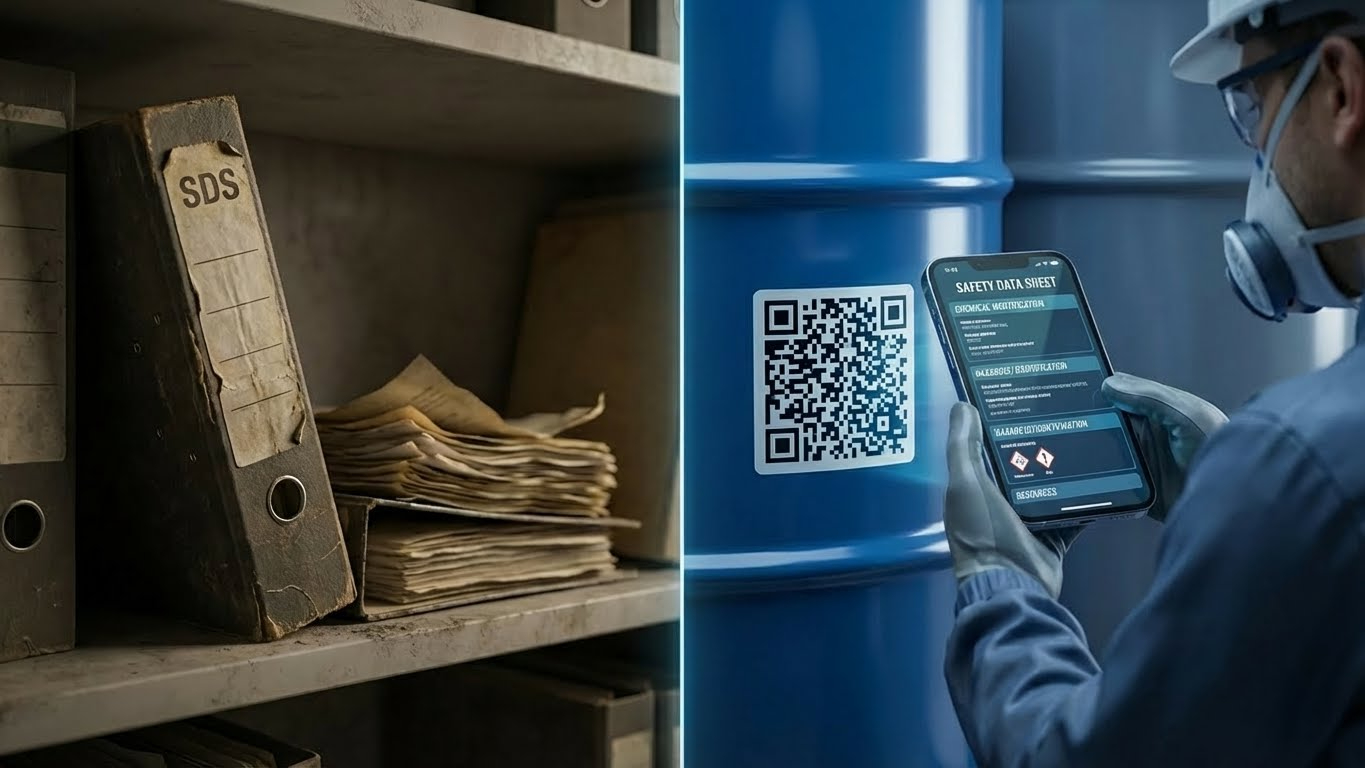
- The Fix: Place point-of-use access directly where chemicals are stored. Using durable QR code labels affixed to chemical storage lockers, cleaning carts, and stockroom doors allows any worker to scan and open the exact safety sheet on their mobile device instantly.
3. Mismatched Physical Stock and Digital Inventories
A classic audit trap: the inspector walks the floor, spots a 20-litre drum of solvent in the maintenance bay, and asks to see the corresponding COSHH assessment and SDS. When checking the register, the safety manager discovers the company switched brands six months ago, but the register still lists the old supplier.
A bloated or inaccurate register indicates a breakdown in procurement and COSHH controls.
- Audit Warning Sign: "Ghost chemicals" (products listed on the register that are no longer used) or "Unregistered chemicals" (new products brought on site without prior approval).
- The Fix: Conduct a physical "chemical sweep" of every site once per quarter. Ensure your purchasing department cannot approve chemical invoices without attaching an updated SDS to your digital inventory.
4. Unlabelled or Hand-Written Secondary Decanting Containers
Workplace staff frequently buy bulk chemicals (such as 5-litre concentrates) and decant them into smaller trigger spray bottles or squeeze containers.
The HSE regularly issues enforcement notices for unlabelled, illegibly hand-written, or faded secondary containers. If a clear liquid is stored in an unlabelled spray bottle, an employee or emergency responder has no way of knowing whether it contains mild detergent or caustic degreaser.
- Audit Warning Sign: Permanent marker scribbles on plastic bottles, faded paper stickers, or completely unlabelled containers.
- The Fix: Every secondary container must display the product name, hazard pictograms, and access to safety information. Applying industrial waterproof QR stickers ensures secondary bottles remain compliant without requiring custom-printed commercial labels for every single bottle.
5. Inadequate Staff Training on SDS Navigation
Having an SDS on file is only half the battle. Auditors often test staff comprehension by asking front-line workers simple questions:
- Where do you look for eye-splash first-aid instructions? (Section 4)
- What type of gloves are required when handling this substance? (Section 8)
- What should you do in the event of an accidental spill? (Section 6)
If a team member struggles to navigate a complex 15-page chemical document during an inspection, the auditor will note a failure in training and instruction.
Summary Checklist: Is Your Business Audit-Ready?
Use this quick checklist to benchmark your workplace today:
| Audit Checkpoint | Compliant? | Action Required |
|---|---|---|
| All active chemicals listed on a central register | [ ] | Run a physical sweep of all cupboards and storerooms. |
| SDS documents reviewed within the last 3 years | [ ] | Request updated sheets from suppliers for older records. |
| Safety data accessible at point-of-use in <30 seconds | [ ] | Deploy QR code access points at storage locations. |
| Secondary/decanted bottles clearly identified | [ ] | Apply waterproof labels with hazard symbols. |
| Staff know how to read Sections 4, 6, and 8 | [ ] | Conduct a 10-minute refresher during your next toolbox talk. |
Modernize Your Chemical Compliance with SDS Flow
Tired of chasing paper binders and replacing stickers every time an SDS changes? SDS Flow allows you to manage your entire chemical inventory online, print permanent QR code labels that never need re-printing, and share instant 48-hour read-only access with HSE auditors.
👉 Start managing your chemical safety for free with SDS Flow
Ready to simplify your COSHH management?
Try our free generator today and see how easy it is to bridge the gap between your workshop floor and your digital safety folder.
Try Free QR Generator